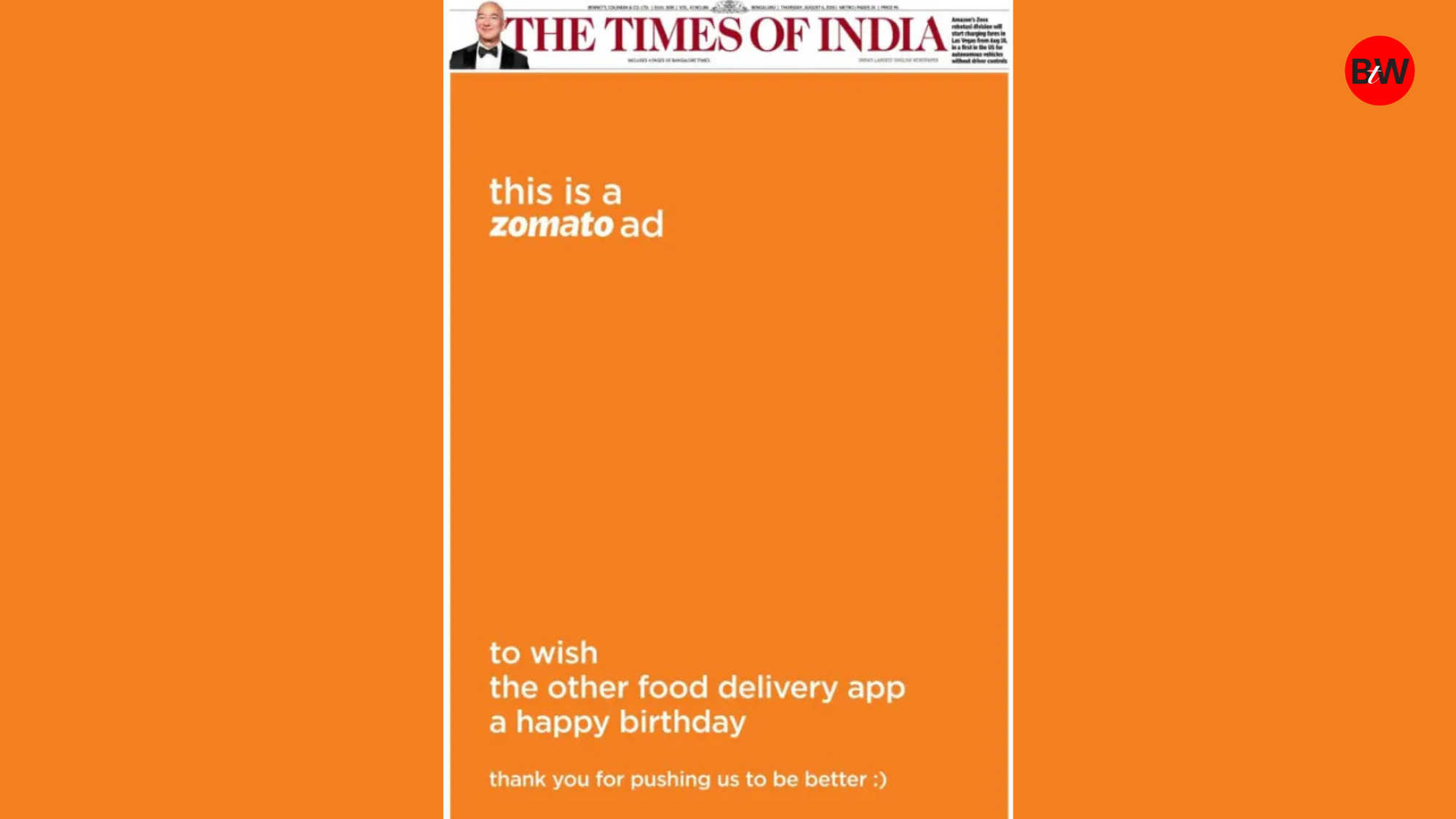
Just weeks after celebrating its own 18th birthday with a logo-free newspaper advertisement that had the country guessing, Zomato has once again grabbed headlines through print. This time, however, the food delivery platform has shifted the spotlight from itself to its biggest rival, Swiggy, marking the competitor's birthday with a witty full-page newspaper advertisement.
The orange advertisement carried a simple yet unexpected message:
"This is a Zomato ad... to wish the other food delivery app a happy birthday."
It concluded with an equally playful sign-off:
"Thank you for pushing us to be better :)."
Instead of using the space to promote offers or products, Zomato chose to acknowledge the role competition has played in its own journey. The move immediately resonated with readers and marketers, adding another memorable chapter to the brand's growing collection of unconventional print campaigns.
A Playful Take on Brand Rivalry
Competition in the food delivery business is often viewed through the lens of discounts, market share, and customer acquisition. Zomato's latest campaign takes a different approach by celebrating the presence of its biggest rival instead of competing with it.
The line, "Thank you for pushing us to be better," subtly recognises that healthy competition has encouraged both brands to innovate and improve over the years. Rather than positioning Swiggy as an opponent, the advertisement frames the relationship as one that has contributed to the evolution of India's food delivery ecosystem.
The campaign also reflects the playful, self-aware tone that has become synonymous with Zomato's communication style, where humour and cultural relevance often take precedence over direct product messaging.
According to the company, the campaign is built around the idea that meaningful competition benefits not just brands, but also customers. By publicly acknowledging Swiggy on its birthday, Zomato transforms what could have been a routine brand message into a celebration of the rivalry that has shaped India's quick-commerce and food delivery landscape.
Keeping Print Relevant in a Digital World
At a time when most brands prioritise digital platforms for attention, Zomato continues to demonstrate that print advertising can still create significant cultural conversations when backed by a strong creative idea.
Its earlier "Guess the Brand" campaign sparked conversations through mystery and minimalism, while the latest newspaper ad relies on wit, surprise, and sportsmanship. Neither campaign centred on discounts or product features. Instead, both used a simple newspaper page to create a story that people wanted to photograph, share, and discuss online.
In doing so, Zomato extended the life of its print campaigns far beyond the newspaper itself, generating earned media and widespread social engagement.
A Masterclass in Brand Confidence
Taken together, the two newspaper advertisements reveal how Zomato is using creativity to strengthen brand equity rather than simply drive transactions. The earlier campaign demonstrated confidence in the strength of its visual identity, while the latest one showcases confidence of a different kind—the willingness to publicly appreciate a direct competitor without weakening its own position. Both campaigns relied on minimal design, concise copy, and a clear creative idea, proving that simplicity can often have a greater impact than elaborate advertising.
The Bigger Marketing Lesson
Zomato's recent newspaper campaigns underline an important lesson for marketers: memorable advertising isn't always about saying more—it's about saying something people want to talk about.
Whether encouraging readers to identify a brand without its logo or using premium newspaper space to wish a competitor a happy birthday, Zomato has shown that strong brand equity allows companies to move beyond conventional advertising.
From "Guess the Brand" to "Happy Birthday, Swiggy," Zomato has turned two simple newspaper pages into marketing moments that travelled across newsrooms, social media feeds, and industry conversations. In an era crowded with promotional messages, the brand has demonstrated that creativity, confidence, and a touch of humour can still make print one of the most powerful storytelling platforms.