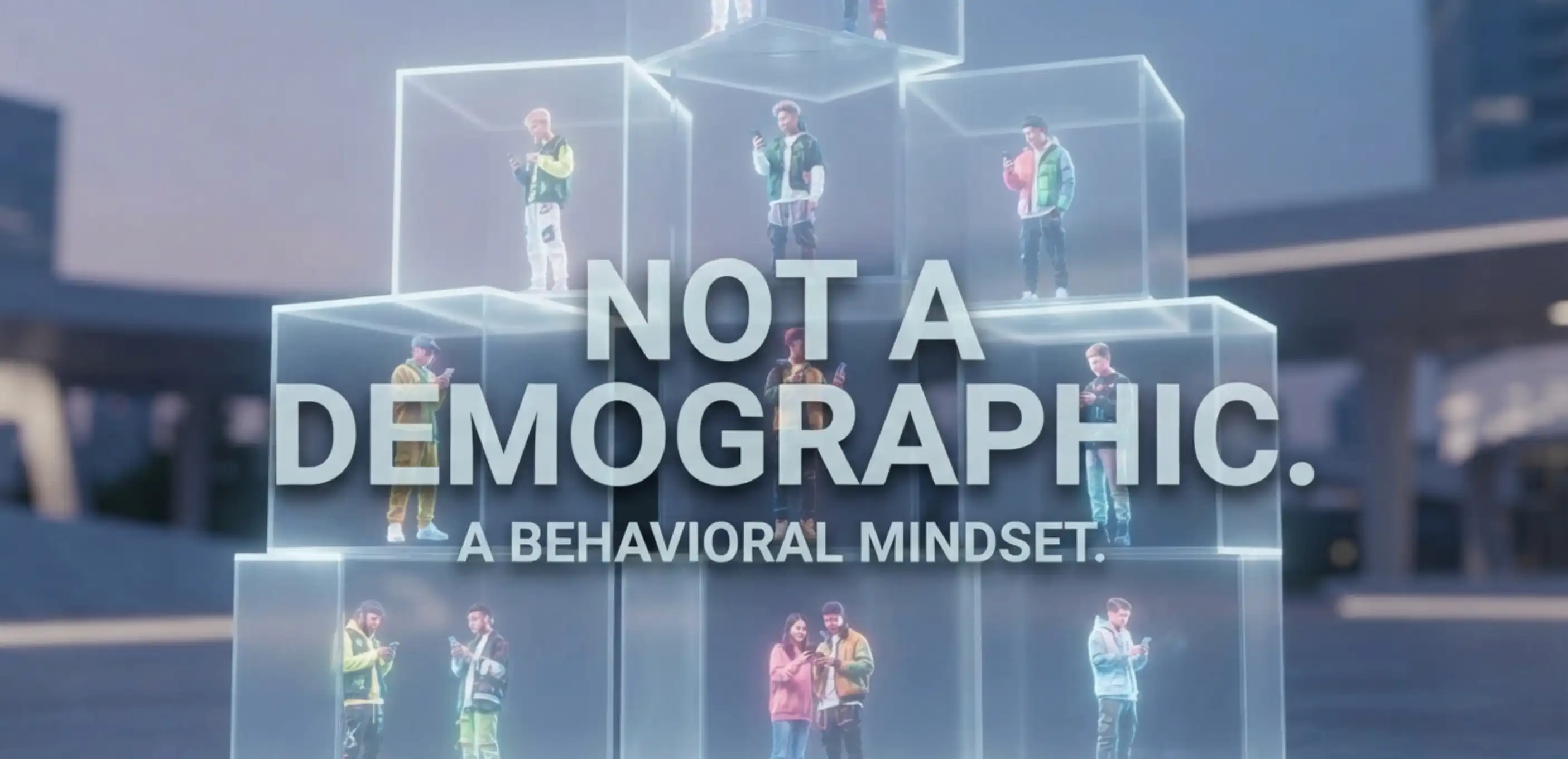
For years, marketers have been trained to think of generations as demographic segments: Millennials, Gen X, Gen Z. Useful labels, certainly, but increasingly inadequate for understanding what is happening in the Indian marketplace. Gen Z is not simply the next generation of consumers. It is changing the behaviour of consumption itself. That is why the Gen Z story deserves to be read beyond age, income and population charts.
India still has one of the world’s youngest populations. But the more interesting shift is happening in the way young Indians discover brands, evaluate them, talk about them and ultimately decide whether they belong in their lives. Deloitte FICCI estimates have placed Gen Z at a striking 43% of India’s consumption, with its direct spending power estimated at around $250 billion. The numbers are significant. But the real significance lies elsewhere. Gen Z does not merely consume brands. It interprets them.
For an earlier generation, the basic question was often simple: Is this product good? For Gen Z, the questions are multiplying. What does this brand stand for? Is it relevant to me? Does it feel authentic? What is the experience like? Can I share it? Does it say something about who I am?
This is a profound change because consumption has always been partly functional and partly emotional. Gen Z is making it increasingly cultural and identity driven.
Look at the brands that have understood this shift. Zepto did not simply enter the grocery market with another promise of convenience. Its communication adopted the speed, humour, cultural references and irreverence of the internet itself. Blinkit turned everyday commerce into a communication platform, often making the brand feel less like a retailer and more like a participant in popular culture. Zomato and Swiggy similarly understood that their social presence could have a personality of its own. Their communication often works because it feels like something a consumer might actually say, rather than something a brand committee has approved. Gen Z does not necessarily want brands to behave like teenagers. It wants them to understand the culture it lives in.
That is why brands such as boAt have been able to build strong cultural visibility by combining product, music, entertainment, creators and youth culture. Nykaa has built a beauty ecosystem where discovery, content, community and commerce increasingly exist together. Brands such as Snitch and Rare Rabbit have understood that fashion is not simply about clothing. It is about aspiration, identity and the visual language through which young consumers present themselves.
The larger lesson is that Gen Z does not always separate advertising from entertainment, commerce from content or brand from culture.
The boundaries have blurred.
A sneaker is not only a sneaker. A café is not only a café. A phone is not only a phone. A piece of jewellery is not only an asset or an ornament. Each can become a statement of taste, values, belonging and self expression.
And this is where the influence of Gen Z extends far beyond Gen Z itself. Young consumers may be the early adopters, but their behaviours travel. Parents discover brands through their children. Older consumers adopt digital habits once considered youthful. New visual languages move from social media into mainstream advertising. What begins as a Gen Z behaviour can quickly become a wider consumer behaviour.
Gen Z, therefore, is less a demographic opportunity and more a behavioural signal. Perhaps nowhere is this shift more visible than in luxury. The traditional language of luxury has been built around scarcity, heritage, craftsmanship and status. Those things have not disappeared. But the meaning of luxury is becoming more personal.
Recent Vogue reporting on Indian Gen Z points towards a consumer increasingly interested in meaning, creativity, cultural relevance and value rather than status signalling alone. That does not mean Gen Z has rejected luxury. Quite the opposite. It wants luxury to mean something. The old luxury equation was relatively straightforward: price, exclusivity and status.
The emerging equation is more nuanced: craft, meaning, identity and experience. That is why a younger consumer can simultaneously admire a heritage luxury house and discover a niche Indian designer on Instagram. The two are no longer necessarily contradictory. One represents legacy. The other represents discovery.
This is also where brands such as Nike have remained culturally powerful. Nike rarely sells only a shoe. It sells participation in a culture of sport, ambition, individuality and self belief. Spotify similarly transformed music consumption into something intensely personal, with products such as Wrapped turning individual listening behaviour into identity and social currency.
The consumer does not simply receive the brand.
The consumer becomes part of the brand story.
There is another important shift. For decades, brands controlled the conversation. They made the product, created the campaign, bought the media and told consumers what the brand meant.
That model is becoming increasingly difficult to sustain. Gen Z has grown up in an environment where consumers can respond instantly, review publicly, remix brand content, create their own narratives and influence thousands of others. The consumer is no longer at the end of the communication chain.
The consumer is inside the communication system. Duolingo is an interesting example of what happens when a brand understands this reality. Its social communication often behaves less like traditional advertising and more like internet culture. The brand has created a recognisable personality that can participate in conversations, trends and memes without appearing to be desperately chasing them.
That is the difference between using social media and understanding social culture. A brand cannot simply manufacture relevance through advertising. It has to earn relevance through behaviour. Authenticity becomes particularly important because Gen Z has grown up surrounded by branded content and can recognise advertising quickly. More importantly, it can recognise when a brand is attempting to sound culturally relevant rather than actually being relevant.
A brand can borrow a trend. It cannot easily borrow credibility. Experience is becoming another important part of the equation. Consumers increasingly remember not just what they bought, but how a brand made them feel. Discovery, packaging, retail, digital interaction, customer service, delivery, social content and post purchase engagement are no longer separate experiences.
Together, they are the brand. This is particularly important in categories where functional differences between products are becoming smaller. When everyone has a good product, experience becomes differentiation.
For Gen Z, the experience can be as shareable as the product itself.
A restaurant can become a social destination. A store can become content. Packaging can become a photograph. A campaign can become a conversation. A product launch can become a cultural moment.
The brand is no longer merely something you buy.
It is something you participate in. Perhaps the biggest lesson for marketers is that Gen Z does not always ask, “Is this brand good?” It increasingly asks:
“Is this brand me?” That is a very different question.
Brands have historically been built around positioning: what we stand for, who we target and why consumers should choose us. The next generation of brand building requires an additional question: What does choosing us allow the consumer to say about themselves?
This is why cultural relevance matters. It is why local stories can become premium. It is why Indian craft can become contemporary luxury. It is why a familiar cultural code, when interpreted intelligently, can feel more distinctive than a borrowed global aesthetic.
It is also why brands that understand identity can create stronger relationships than brands that merely communicate features.
The mistake would be to respond to Gen Z by simply making everything younger: more slang, more reels, more memes, more influencers, more colourful campaigns.
That is not the transformation. The deeper transformation is from communication to participation, from status to meaning, and from demographic targeting to behavioural understanding.
The smartest brands will not ask, “How do we advertise to Gen Z?”
They will ask: “What has changed in the way people decide what deserves their attention, money and identity?”
That question is much bigger than Gen Z. Because generations eventually age.
But behaviours travel. And perhaps that is the real Gen Z story in India.
It is not that a new generation has entered the market.
It is that the market is beginning to behave like them.