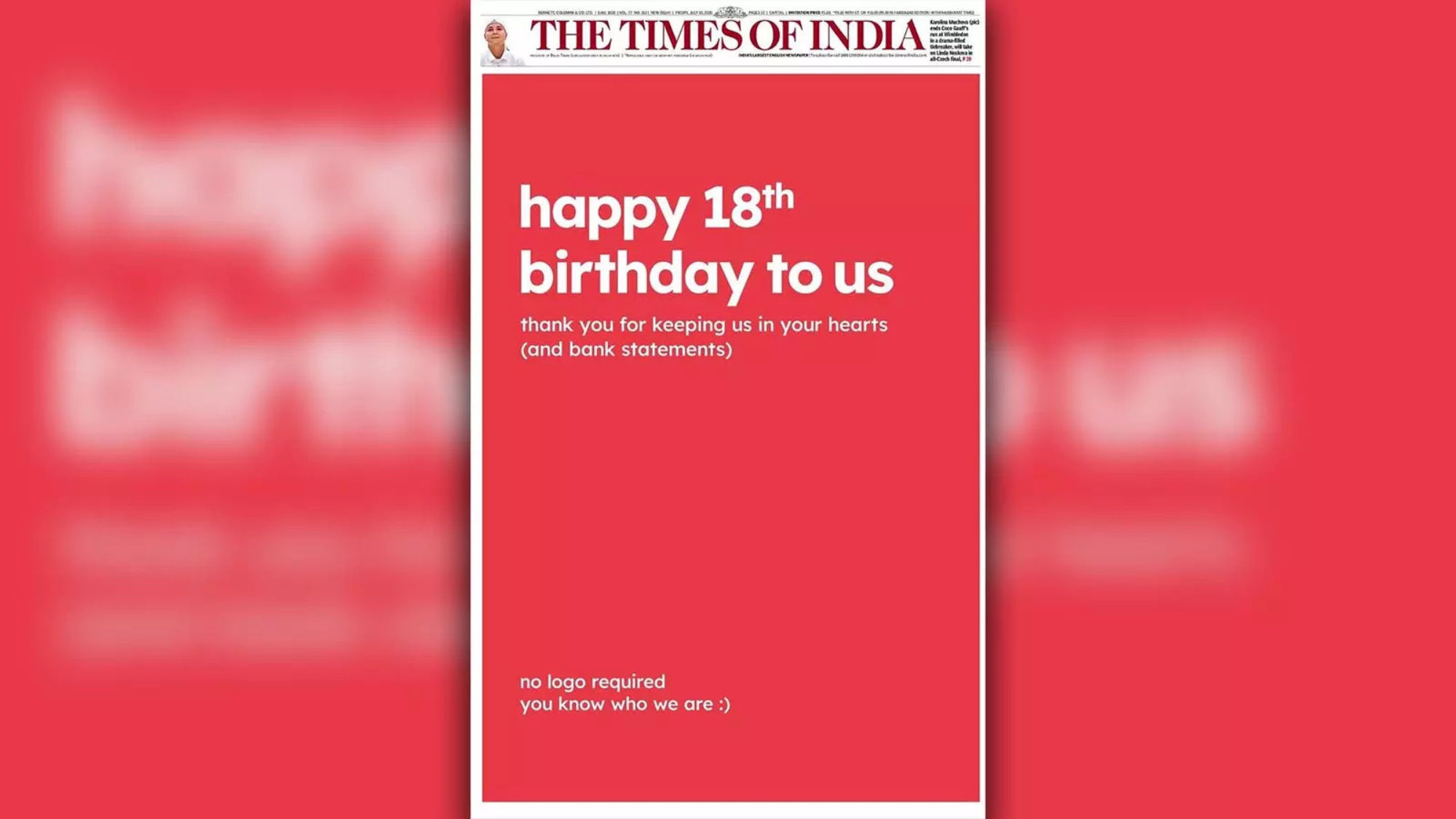
So, on 10 July, when the Times of India landed on your doorstep, you picked it up and found a full, bright-red page with simple white text — no logo, no images, no discounts, just two lines:
“Happy 18th birthday to us. Thank you for keeping us in your hearts (and your bank statements).”
And at the bottom, a cheeky note:
“No logo required. You know who we are :)”
You skip it like any other daily ad or guess that it is Zomato. That’s exactly how Zomato celebrated its 18th birthday, by breaking traditional advertising rules and deliberately leaving readers to guess who placed the ad.
The Viral Guessing Game That Took Over Social Media
The striking red page quickly turned into a nationwide guessing game. Many people were confused and started guessing the brand on social media. Common guesses included Airtel, Kotak Mahindra Bank, Coca-Cola, Vi, Netflix, and redBus.
One user on X asked: “Airtel? Vi? Netflix India? Zomato? Can you guess without looking at the replies?” The post received hundreds of replies as people debated and shared their thoughts. The conversation spilled from newspapers to X, LinkedIn, and even WhatsApp groups.
Challenging Old Advertising Rules
For years, advertisers have believed that the logo is the most important part of any ad. As the Famous advertising legend David Ogilvy once said,
“Making the logo twice the size is often a good thing to do, because most advertisements are deficient in brand identification. Showing the clients' faces is also a better stratagem than it may sound, because the public is more interested in personalities than in corporations. Some clients can be projected as human symbols of their own products.”
However, Zomato boldly challenged this old thinking. By removing its logo completely and using only its signature red colour, the company tested whether people could recognise the brand without seeing its name.
As one of the marketers shared a clear example on LinkedIn. He identified the ad as Zomato immediately, but his wife did not. She called it bold but overconfident, noting that the same red page could easily belong to Airtel or Kotak Mahindra Bank.
The Power of Red: Zomato’s Strongest Visual Asset
The red colour was the real hero of this campaign. Zomato has used this vibrant shade for many years across its app, packaging, delivery bags, and marketing materials. Over time, it has become one of the strongest visual assets in Indian food delivery.
With this ad, the company showed strong confidence that Indian consumers now strongly connect red with Zomato, even without the logo. This was a clever test of brand recall. It asked a simple but powerful question: Has our colour become strong enough to stand alone?
For its app users, Zomato sent a push notification with a special ₹180 birthday discount. For newspaper readers, the plain red page created curiosity and sparked conversations both online and offline. Many people even used AI tools to recreate the ad with Zomato branding for fun.
A Bold New Style: Redefining Modern Advertising
Zomato’s logo-free red ad proved that strong, mature brands can successfully break old advertising methods and still succeed. Instead of shouting its name with big logos and flashy visuals, Zomato chose minimalism, intelligence, and confidence.
This clever approach made people stop, think, and actively engage with the brand, something most regular advertisements fail to achieve. In today’s world, where consumers are bombarded with thousands of ads daily, creating curiosity is often more powerful than direct selling.
The campaign quickly became a hot topic across news channels, marketing forums, and social media. Industry experts praised it for testing the limits of brand equity, while others debated whether it was brilliant or slightly risky.
Zomato also joined the conversation with its signature humour on X:
“We’ve come a long way over the past 18 years, from getting cancelled on Twitter to getting cancelled on X. Happy birthday to us.”
Whether you guessed Zomato correctly at first sight or got completely confused, one thing is clear: Zomato successfully turned its 18th birthday into a memorable and viral moment. This simple red page not only challenged old advertising rules but also beautifully demonstrated the true power of brand confidence and visual identity in the modern era.
In the end, Zomato didn’t just celebrate 18 years; it reminded everyone that sometimes, saying less can make a much bigger impact.