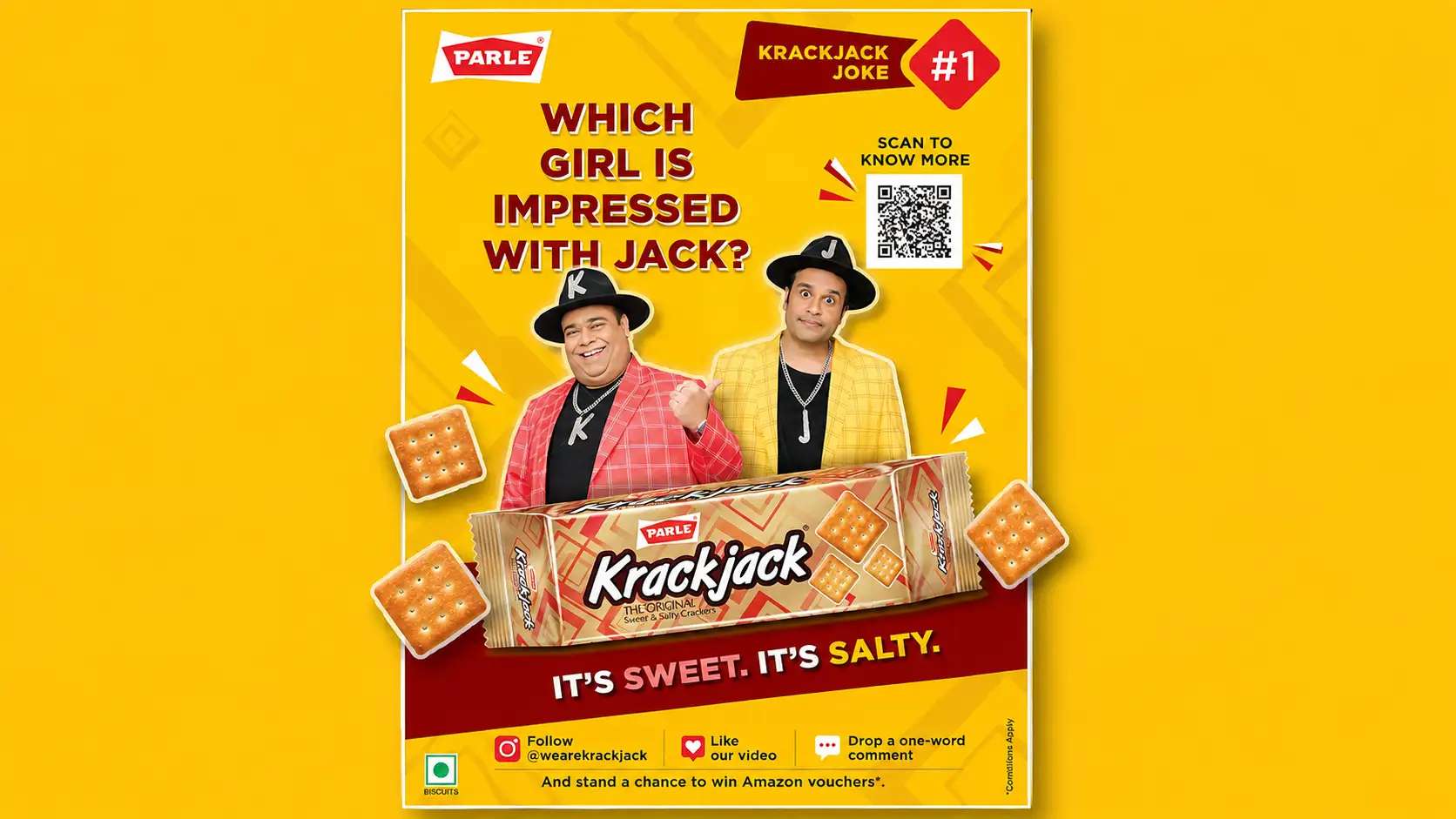
In an industry dominated by algorithms, influencers, and real-time metrics, print advertising is frequently dismissed as outdated. For Parle’s Krackjack, however, it remains a deliberate and valued part of the communications mix. While many brands have shifted the bulk of their budgets to digital, Krackjack continues to leverage the credibility, focused attention, and lasting impact that print uniquely delivers.
The latest campaign is the newest step in one of Parle’s longest-running brand ideas. Ever since Krackjack launched in 1972 as a sweet-and-salty biscuit, the company has used two opposing characters—Krack and Jack—to bring the dual taste to life. Across the years, a line of performers has stepped into those roles.
Now the baton has passed to Krushna Abhishek and Kiku Sharda. Their natural comic spark helps keep the brand’s light-hearted personality strong while opening it up to a younger set of consumers.
What distinguishes this chapter is the media strategy. Unlike earlier Krackjack efforts that relied primarily on television and digital, the latest campaign opens in print before guiding readers online. In a landscape where most launches are digital-first, this choice stands out.
The decision is not an either-or between print and digital. It is a recognition of each medium’s distinct strengths and a commitment to using them together.
“We don’t see print and digital as competing mediums. Print helps us start meaningful conversations, while digital helps us scale them. The real strength lies in making both work together,”
Says Mayank Shah, Vice President, Parle Products.
This philosophy has guided Krackjack’s media planning for years. Campaigns frequently begin in newspapers, introducing the core message in a trusted, relatively distraction-free environment. Once the narrative is established, digital channels expand reach, drive engagement, and sustain the conversation.
The approach reflects a clear understanding of audience behaviour. Newspapers still command substantial readership across India, especially among families and household decision-makers. For a mass-market brand like Krackjack, print reaches consumers during moments of focused attention—moments that are increasingly rare in today’s crowded digital feeds.
“Print gives us a unique combination of credibility, attention, and reach. It helps us establish the core narrative of a campaign before digital channels take that story further through engagement and amplification,” Shah explains.
Print’s enduring strength also lies in its simplicity. A strong visual, a sharp headline, and a clear brand message can cut through more effectively on a newspaper page than in a saturated social feed. Digital platforms excel at precise targeting and measurable results; print offers permanence and authority. Both qualities continue to resonate.
Krackjack’s strategy challenges the idea that digital transformation means abandoning traditional media. Instead, it demonstrates a more practical reality: the strongest campaigns often combine older and newer channels to achieve complementary goals.
In many ways, the brand’s media approach mirrors its brand-building philosophy. Just as Krackjack has refreshed the Krack-and-Jack pairing across generations while remaining true to its sweet-and-salty essence, it adopts digital innovation without discarding the proven strengths of traditional media. The campaign featuring Krushna and Kiku embodies that balance—contemporary in execution, yet firmly rooted in a decades-old idea.
This integrated mindset is increasingly relevant in a fragmented media environment. Consumers move fluidly between print, mobile, social platforms, streaming services, and more. Relying on any single channel limits impact. A coordinated strategy allows brands to capture attention at multiple points and reinforce messages over time.
For Krackjack, print provides the spark; digital serves as the amplifier. Together they create an ecosystem that pairs trust with scale, focused attention with ongoing engagement, and heritage with modern relevance.
As marketers debate the future of advertising, Krackjack offers a useful reminder. The real question is not whether print or digital matters more. It is how each medium can contribute to a larger brand story. In that story, print still has a meaningful role to play.
As Shah puts it, “Digital may amplify a message, but print often gives it the credibility to resonate in the first place.”