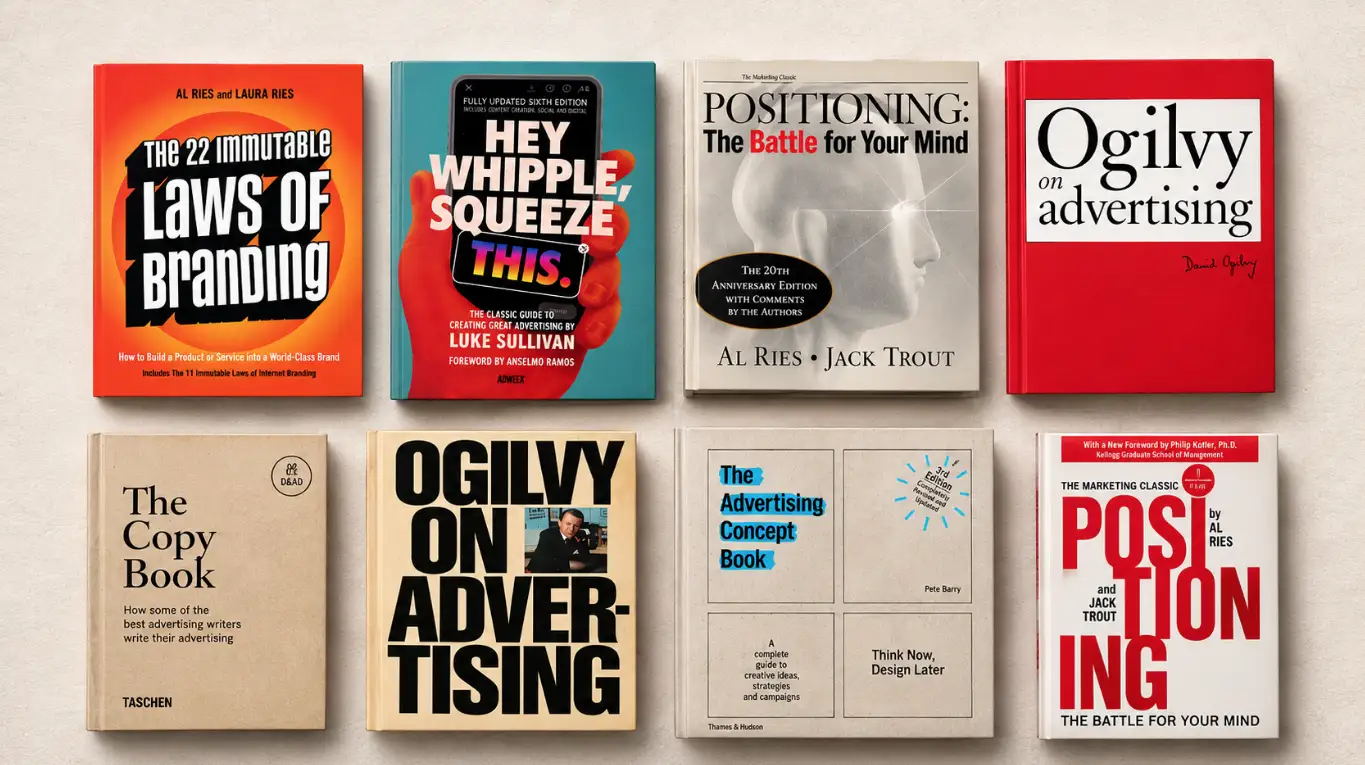
Today, advertising has moved from television and print to YouTube, Instagram, Reels, influencers and countless digital platforms. Yet, the fundamentals remain surprisingly unchanged. Some of the best lessons in advertising and branding still come from books written years ago.
Here are five books that offer a strong foundation for anyone who wants to understand advertising, branding and creative thinking.
1. Ogilvy on Advertising - David Ogilvy
If there is one book that explains the fundamentals of advertising, this is a natural place to start.
David Ogilvy talks about headlines, copywriting, research, positioning, print advertising, television commercials and how advertising should ultimately contribute to the business. The book also examines what makes advertising work and what makes it fail.
One of its strongest lessons is that creativity should not exist simply to win applause. Advertising has a job to do: communicate, persuade and sell.
A clever advertisement is not necessarily a good advertisement. A good advertisement is one that people understand, remember and act upon.
2. Positioning: The Battle for Your Mind -Al Ries & Jack Trout
This book shifts the conversation from creating advertisements to creating a place for the brand in the consumer's mind.
Consumers are exposed to thousands of messages. They cannot remember everything. Positioning is therefore about owning a clear and distinctive space in their minds.
The central idea is that a brand needs a clear concept that consumers can immediately associate with it. Al Ries describes positioning as finding the right “rock”—a simple concept that differentiates a brand in the category.
In today's crowded digital environment, this lesson has become even more relevant: if your brand stands for everything, it may end up standing for nothing.
3. The 22 Immutable Laws of Branding-Al Ries & Laura Ries
This book looks at branding through a set of simple principles.
It explores ideas such as focus, category leadership, brand names, perception, consistency and the dangers of trying to stretch a brand too far. The book also extends these ideas into internet branding.
One important thought is that brands become stronger when they have a clear meaning. Constantly adding products, messages or promises may make a business bigger, but it does not necessarily make the brand stronger.
The fundamental lesson is simple: build a clear brand before trying to build a bigger brand.
4. Hey, Whipple, Squeeze This - Luke Sullivan
This is a book for anyone who wants to understand the creative side of advertising.
Luke Sullivan takes readers inside the advertising process—how ideas are found, how campaigns are developed and how copy, visuals and storytelling come together.
The newer edition also looks at brand stories, Instagram, YouTube and the changing social-media landscape, while retaining the classic creative principles of earlier editions.
Its big takeaway is that great advertising does not always come from saying more. Sometimes it comes from finding one interesting idea and expressing it simply.
5. The Advertising Concept Book - Pete Barry
For anyone working in creative advertising, this is particularly useful because it focuses on the most important part of a campaign: the idea.
Pete Barry explains how to move from a brief to an insight and from an insight to a creative concept. The book covers copywriting, the creative process, agency working and different media, including integrated and social advertising.
It reminds us that beautiful execution cannot rescue a weak idea.
The lesson is straightforward: before asking how an advertisement should look, ask what the advertisement should say and why people should care.
What These Five Books Teach Us
Interestingly, these five books approach advertising from different directions.
Ogilvy teaches us the fundamentals of effective advertising.Ries and Trout teach us the importance of positioning.Ries and Ries explain how brands build meaning and focus.Luke Sullivan takes us into creative thinking and execution.Pete Barry puts the spotlight on the power of the concept.
Together, they make one thing clear: technology changes, platforms change and consumer habits change—but the fundamentals of good advertising remain remarkably constant.
The tools may be different today. The question is still the same:
Is the idea clear? Is it relevant? Is it memorable? And does it make the brand matter?
That is where good advertising begins and where good branding continues.