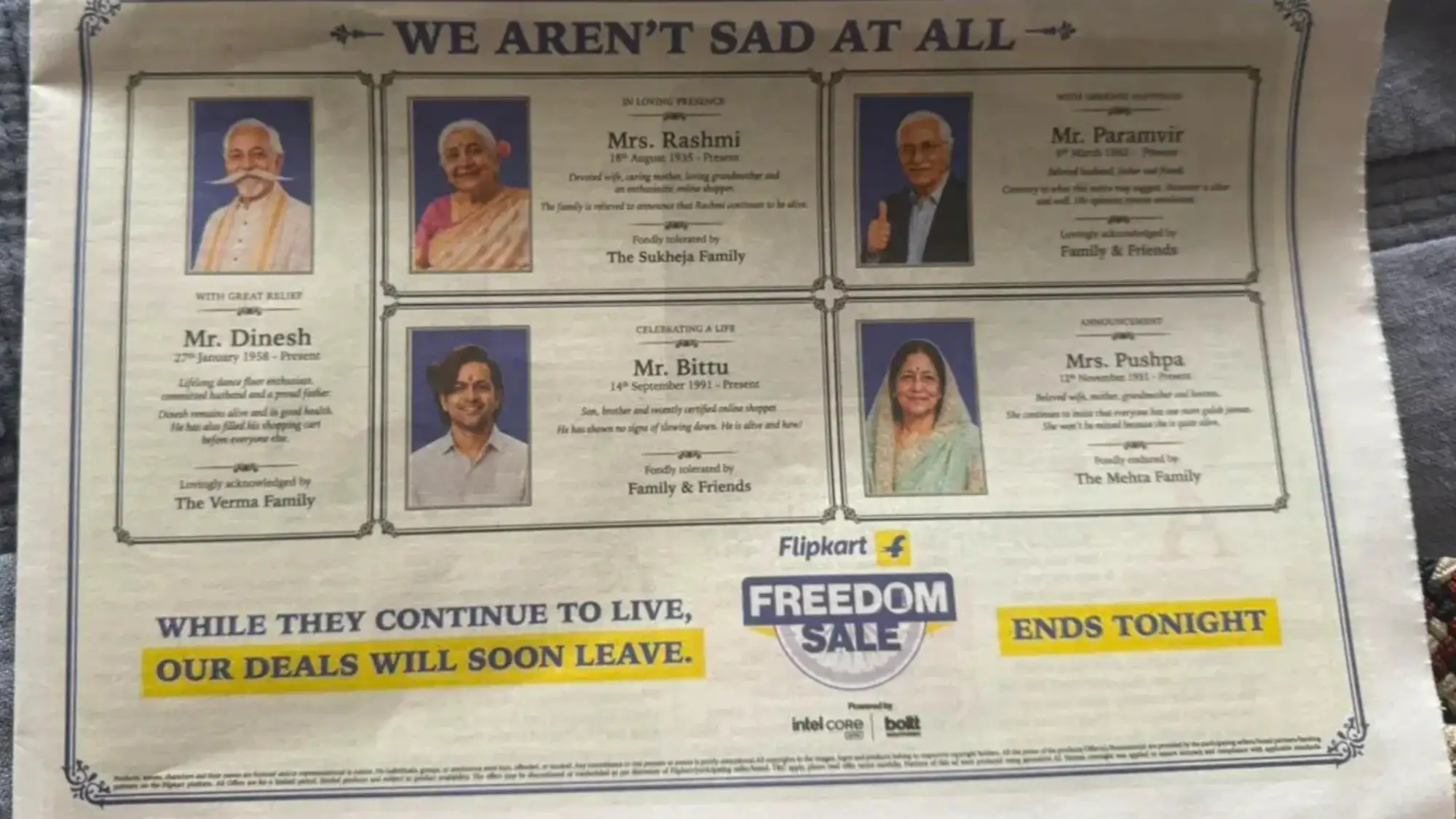
Imagine opening your morning newspaper and finding what appears to be an obituary page. There are photographs, names, ages, and tribute-style messages, all presented in a format usually associated with loss and mourning.
But then you read the headline:
“We aren't sad at all.”
The people featured are alive. What is actually “dying” are Flipkart’s sale deals.
That is the central idea behind Flipkart’s latest Freedom Sale print advertisement. By borrowing the visual language of newspaper obituaries, the brand communicates that its deals are coming to an end. The unusual execution has caught attention, while also sparking a debate around creative sensitivity.
When an Obituary Becomes an Advertisement
The creative works by deliberately creating a moment of confusion. The obituary-style photographs and details initially make readers believe they are looking at announcements of people who have passed away.
The reveal comes through the copy, which makes it clear that the people are alive, while Flipkart’s deals are the ones nearing their end. From an advertising perspective, the idea is designed to stand out in a crowded newspaper. Instead of relying on the usual sale headlines, product images, or discount-heavy layouts, Flipkart uses a familiar editorial format to create curiosity.
The reader first notices the format, then reads the message and discovers the advertising twist. But the same creative choice that makes the advertisement distinctive has also attracted criticism.
Indian novelist Shobhaa De criticised the campaign on X, calling it insensitive and questioning the use of death-related imagery in commercial communication. Other social media users raised similar concerns, while some defended the execution as an example of fictional, dark humour used to create advertising impact.
Advertising often uses provocation and irony to stand out, but an obituary carries strong associations with grief and loss. By using this format, Flipkart has sparked a wider debate on where creative advertising should draw the line.
The campaign proves that being memorable can generate attention, but attention alone doesn't guarantee the right brand impact. While the message is simple, the sale is ending, the creative execution has become the bigger conversation.
For brands, this creates an important lesson. Breaking conventional advertising rules can make people stop and look, but the cultural and emotional meaning behind the chosen format also matters.
Flipkart's campaign certainly succeeds in making a routine sale announcement feel unexpected. Whether audiences see it as clever dark humour or an unnecessary creative risk, the advertisement has demonstrated the power and the responsibility of using provocative ideas.
In the end, the campaign isn't only about deals coming to an end. It has opened a larger conversation about how far brands should go to capture attention in an increasingly cluttered advertising landscape.