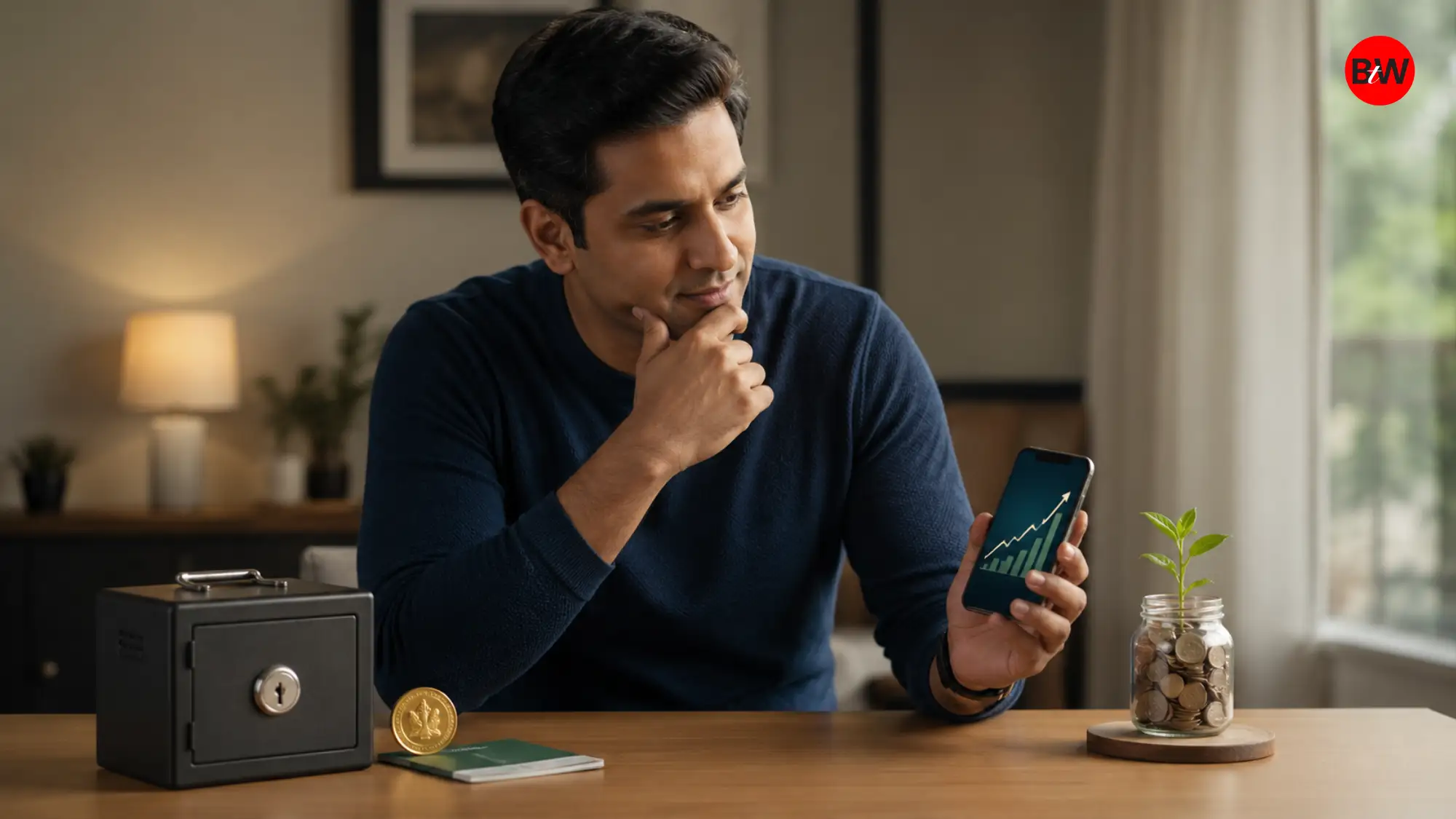
For decades, the Indian financial mindset could be summed up in three words: earn, save and protect. The preferred financial products were familiar and trusted: bank savings accounts, fixed deposits, gold, insurance, PPF, provident funds and, for those who could afford it, property. The Indian consumer did not necessarily want the highest return; he wanted certainty. Money was something to be protected because it represented the family's security. But a new India is emerging. Consumers are increasingly asking a different question: “If I am saving every month, why shouldn't my money also grow?” That behavioural shift is at the heart of India's mutual-fund opportunity.
The numbers show how significant this change has become. India's mutual-fund industry had 26.63 crore folios by January 2026, while SIP assets stood at ₹16.36 lakh crore. By June 2026, monthly SIP collections were ₹31,781 crore. More importantly, this is not simply a story of affluent metro investors. The industry is broadening geographically and behaviourally. AMFI-Crisil's analysis shows that individual investors' mutual-fund assets increased 14.2% year-on-year to ₹50.95 lakh crore in May 2026. Individuals were also strongly equity-oriented, with 64.4% of their mutual-fund AUM in equity-oriented schemes. This tells us something important: the Indian consumer is gradually becoming comfortable with market-linked investing.
But the more interesting story is behaviour, not AUM. The Indian consumer is learning to invest regularly instead of waiting for the “right time”. SIP has made investing look less like a financial event and more like a monthly household habit. In that sense, SIP has done for investing what EMI did for consumption, and UPI did for digital payments: it converted something that once required consideration into something that can become routine. The consumer may not understand every technical term in a mutual fund, but increasingly understands the behavioural idea behind SIP: put something aside regularly and allow time to work.
This is where the famous
“Mutual Funds Sahi Hai”
campaign deserves serious recognition as one of India's important category-building exercises. AMFI did not initially try to sell one fund over another. It sold the idea that mutual funds belonged in the Indian financial conversation. The campaign made SIP, diversification, risk, and long-term investing more familiar through simple language and everyday situations. Today, the official Mutual Funds Sahi Hai channel continues to use films around staying invested, retirement, saving versus investing, risk, and investor awareness. For Brand To Watch, this is a classic lesson in advertising: before brands can compete within a category, somebody has to make consumers believe in the category itself.
The next stage, however, is much more difficult. India now knows that mutual funds exist. The consumer's next question is “Which one?” That is exactly where Axis Mutual Fund's Which Mutual Fund, Not Why Mutual Fund campaign becomes interesting. The brand recognised that the category had moved beyond basic awareness and that investors now needed help navigating choice and risk. Its communication also used the Risk-o-meter to help investors think about their risk profile. This is an important evolution in financial advertising: the conversation is moving from category education to decision education.
The Indian consumer is also becoming more self-directed. The 2025 SEBI Investor Survey provides a fascinating insight into how investors discover financial information. Friends, family and colleagues remain important, but social-media financial influencers, online investment communities, financial news and blogs are now significant information sources. This means that the traditional bank manager, insurance agent or mutual-fund distributor is no longer the only financial voice in the consumer's life. YouTube, Instagram, WhatsApp groups, podcasts and online communities are increasingly influencing financial decisions. The new investor may hear about a SIP from a colleague in the morning, watch a YouTube explainer at lunch, and open an investment app at night.
This creates both an opportunity and a responsibility for financial brands. Financial literacy is becoming brand communication. ICICI Prudential Mutual Fund, for example, has built content properties such as Mutual Funds Ka ABC and Paiso Ki Pathshaala, using short-form videos, storytelling, micro-drama, and multiple languages to explain SIPs, investment styles, asset allocation, and long-term wealth creation. The strategic lesson is powerful: a financial brand that teaches consumers can become more than a product provider. It can become a financial companion.
HDFC Mutual Fund is taking a similarly human route. Its
Hum Sab Investors Hain campaign
, part of its Zindagi Ke Liye SIP platform, uses an everyday family story to explain the philosophy of disciplined investing. Instead of showing stock-market screens or financial experts, the film connects financial investment with the emotional investments people already make in their families. This is perhaps where financial advertising needs to go: less finance, more life. The consumer does not wake up thinking about asset allocation. She wakes up thinking about her child's future, her parents, her home, her business, her retirement, and her family's security.
That is also why Nippon India Mutual Fund's 2026 Har Ghar Investor campaign is strategically interesting. The campaign is designed to encourage at least one member of every household to become an investor. Its broader idea, Har Indian Investor, recognises that despite India's enormous investor base, a very large population is still outside the mutual-fund journey. This is where the next big opportunity lies: India does not need only more investors; it needs more first-time investors from ordinary households.
And the Indian household is not going to abandon FDs because mutual funds are growing. That would be a fundamental misunderstanding of the consumer. The FD has a psychological advantage that no advertising campaign can easily remove: certainty. RBI data continues to show the enormous role of deposits in household financial assets, alongside insurance, provident and pension funds. As of July 2026, RBI data showed term-deposit rates above one year broadly around 6.00–6.75%, illustrating why deposits continue to have a clear, understandable proposition for conservative savers. The consumer is therefore unlikely to choose “mutual funds instead of FD” in absolute terms. More likely, he will increasingly choose FD for certainty and mutual funds for long-term growth.
This is the real opportunity for banks as well. Banks have historically owned the customer's money because the savings account was the starting point of the financial relationship. But today's customer can have a bank account with one company, a mutual fund SIP through another platform, insurance somewhere else, a demat account elsewhere, and gold through yet another digital service. The financial relationship is fragmenting. Banks therefore need to move from being merely places where money is kept to becoming platforms that help consumers organise, protect and grow money.
The competition is no longer only between HDFC Bank, SBI, ICICI Bank or Axis Bank. It is between banks, AMCs, fintech platforms, stockbrokers, insurance companies, wealth managers and increasingly digital-first financial ecosystems. The consumer does not care about the industry's organisational structure. He simply wants an answer to one question: “What should I do with my money?” The winning brand will be the one that can answer that question most simply and credibly.
There is another major shift that deserves attention: women are becoming a bigger part of the investment story. AMFI-Crisil's 2025 Factbook noted that women investors accounted for 25.7% of the individual investor base, while systematic investing and longer holding periods were becoming increasingly important. This creates a huge communication opportunity. Traditional financial advertising often talks to “the investor” as if that person is automatically male. But the Indian financial household is changing. Women are increasingly making, influencing, and independently managing financial decisions. The next generation of financial advertising will need to reflect this reality.
Young India is another major force. Millennials and Gen Z have grown up with digital payments, food delivery, e-commerce, and app-based services. They are less intimidated by digital financial products than previous generations. But familiarity with technology does not automatically mean financial literacy. This is why the industry has to make investing simple without making it simplistic. A young consumer may understand how to buy a stock in thirty seconds but may not understand why diversification, risk appetite and time horizon matter. The role of communication is therefore shifting from merely attracting investors to creating better investors.
The regional opportunity may be even bigger. India's next wave of mutual-fund participation will not come only from Mumbai, Delhi, Bengaluru and other metros. It will increasingly come from Tier-2, Tier-3 and smaller cities. The language of financial communication therefore needs to become genuinely Indian. Not merely English advertising translated into Hindi, but stories rooted in the lives of people in Indore, Bhopal, Jaipur, Lucknow, Surat, Nagpur, Patna, Kochi, Coimbatore and hundreds of smaller cities. The consumer may use English at work, Hindi at home, and his regional language with his parents. Financial brands that understand this code-switching will have an enormous advantage.
The creative opportunity is therefore enormous. Financial advertising has historically been obsessed with numbers, interest rates, return, tax saving, corpus, investment period, and performance. But money itself is emotional. A SIP is not really about ₹5,000 a month. It is about a child's future. A retirement fund is not really about CAGR. It is about independence. A diversified portfolio is not really about asset classes. It is about sleeping better when one market falls. This is where financial brands can build emotional differentiation without making irresponsible promises.
AMFI's current communication is also beginning to address the other side of the digital financial world: misinformation and fraud. Its recent investor-awareness communication warns consumers about online investment scams, fake fund managers, suspicious links, and requests for sensitive information. This is becoming an important part of the category's future. Trust will not simply mean “my fund performed well”. Trust will increasingly mean “this brand will not manipulate me, confuse me, or expose me to unnecessary risk.”
There is therefore a fascinating paradox in the Indian financial market. India has more financial information than ever before, but the consumer may not necessarily have more financial understanding. There are influencers, apps, calculators, reels, podcasts, WhatsApp groups, and market commentary everywhere. The winning financial brands will be those that reduce this noise rather than add to it. The consumer does not need another person shouting about the “next multibagger”. He needs someone who can say: understand your goal, understand your risk, invest appropriately, stay disciplined, and give your money time.
For Brand To Watch, this makes the mutual-fund and broader savings category particularly interesting. The brands to watch are not necessarily the ones with the loudest advertising or the highest celebrity quotient. They are the brands that understand the new Indian money mindset. AMFI built category trust. HDFC is building an emotional relationship around SIP. ICICI Prudential is building financial literacy. Axis has focused on choice and risk. SBI is connecting investment with life goals and diversification. Nippon India is taking investing into the household. UTI is using investor-awareness campaigns around SIP habits and volatility. Motilal Oswal is using culturally relevant moments such as Valentine's Day to turn SIP into a conversation about long-term commitment. Each is exploring a different piece of the same consumer transformation.
The larger story, therefore, is not “Mutual funds versus FDs.” It is “old saving behaviour versus new financial behaviour.” The Indian consumer will continue to save, but increasingly he will divide his money according to purpose. Some money will remain liquid. Some will seek certainty. Some will provide protection. Some will go into gold. Some will go into debt. Some will participate in India's economic growth through equity. The financial portfolio of the future will be less about choosing one product and more about understanding the job that every rupee needs to perform.
India has spent generations learning how to save money. It is now learning how to deploy money. That is a much bigger behavioural change. Mutual funds are one of the most visible symbols of that transition, but the real story is the rise of the financially aware Indian consumer. The next great financial brand will not simply say, “Invest with us.” It will say, “We understand your life, we understand your money, and we will help you make better decisions.”
And perhaps that is the most interesting Brand To Watch insight of all: India's next financial revolution will not be about products. It will be about confidence.