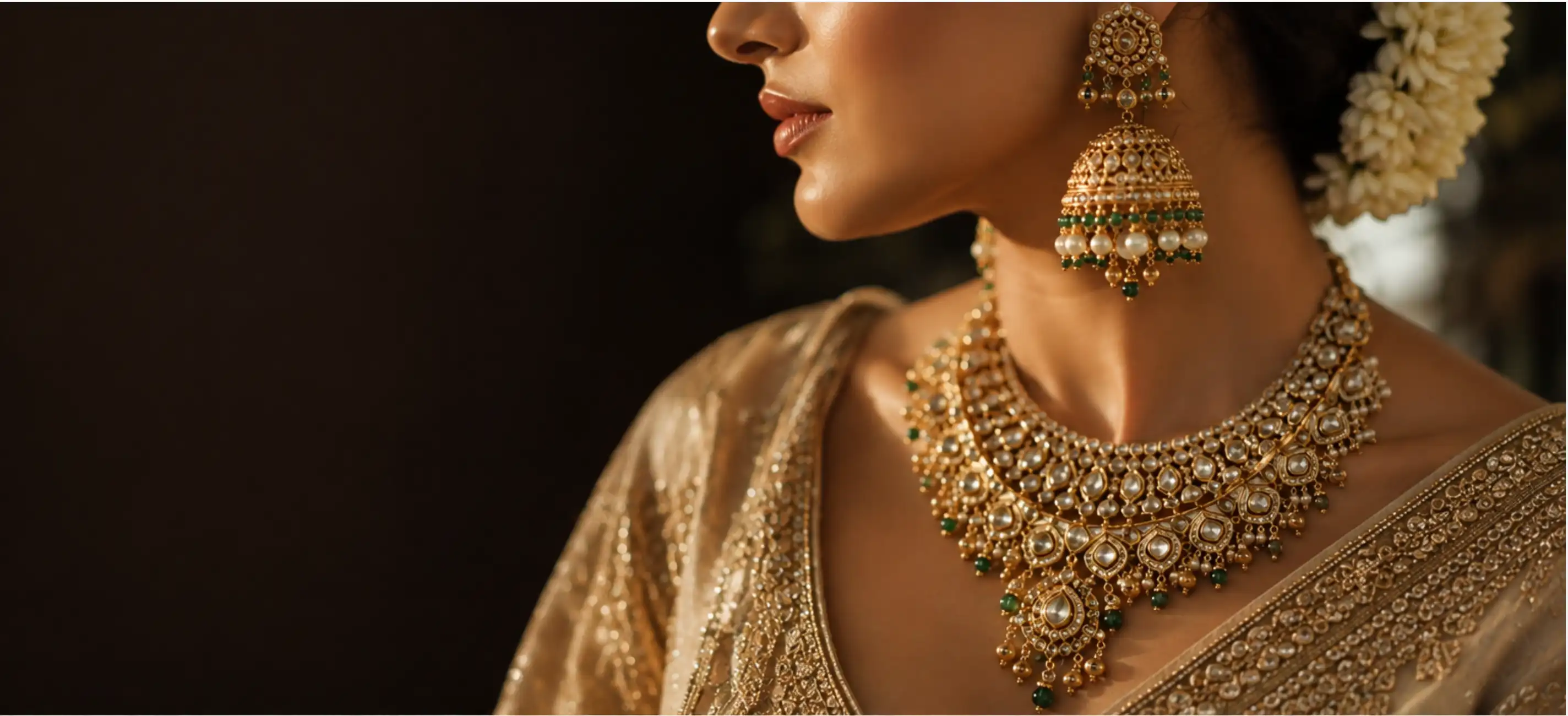
The Jewellery Story Is Changing: From Shaadi Ki Jewellery to Jewellery for the Look
India still buys gold for weddings. But a new jewellery consumer is emerging, one who is buying for the outfit, the occasion, the photograph and, increasingly, for herself.
There are few categories in India where fashion, family, money and emotion come together as naturally as jewellery. For generations, jewellery has been part of the Indian wedding ritual. A bride's jewellery was not simply an accessory. It represented family, prosperity, tradition, and often a form of wealth that could travel across generations. But something interesting is happening now. The Indian jewellery consumer is not walking away from tradition. She is simply adding a new reason to wear jewellery.
She wants jewellery to complete the look.
That sounds like a small change, but it has the potential to reshape the category.
The Indian jewellery market is traditionally divided into bridal, daily wear and fashion jewellery, with significant overlap between the three. The World Gold Council has long identified bridal jewellery as a particularly important part of India's gold consumption. Industry data presented by Kalyan Jewellers puts wedding jewellery at around 60% of the jewellery market, with daily wear at 30% and fashion wear at 10%.
But these boundaries are becoming less rigid.
A necklace can be bridal jewellery on one day and fashion jewellery six months later. A pair of earrings bought for a wedding can become part of a woman's festive wardrobe. A lightweight gold bracelet can be both an investment and an everyday fashion statement. The category is slowly moving from occasion-based jewellery to occasion-plus-fashion-based jewellery.
Shaadi Is Still the Biggest Occasion, But It Is No Longer the Only Occasion
The wedding will remain at the heart of Indian jewellery consumption. There is no reason to believe otherwise. Jewellery is deeply woven into Indian wedding rituals, from engagement rings and mangalsutras to necklaces, bangles, earrings, maang tikas and traditional regional jewellery.
But the modern Indian wedding itself is changing.
There are more events, more outfits and more opportunities to create different looks. Haldi, mehendi, sangeet, cocktail, wedding and reception are no longer necessarily treated as one continuous fashion story. Brides and their families increasingly think about the jewellery that goes with each outfit. That creates a new opportunity for the category.
Instead of selling one large wedding jewellery purchase, brands can build a wardrobe of jewellery around the entire wedding journey. This is where jewellery starts behaving more like fashion.
The Bride Is No Longer Buying Jewellery. She Is Styling Herself
The modern bride is increasingly conscious of the complete look. Jewellery has to work with the lehenga, saree, blouse, makeup, hairstyle, and even the colour palette of the wedding.
This is why bridal jewellery is becoming more experimental. Polki, Kundan, coloured gemstones, layered necklaces, statement chokers and vintage-inspired pieces are being mixed with contemporary silhouettes. Recent wedding fashion coverage has highlighted this combination of traditional forms with more personal and contemporary styling.
The interesting part is that the bride is no longer asking only, “How much jewellery should I wear?”
She is asking: “What jewellery works with this look?”
That is a fashion question.
And once jewellery becomes part of styling, the competitive set becomes much larger.
The jewellery brand is no longer competing only with another jeweller. It is competing with designers, fashion brands, costume jewellery labels, Instagram stores and even the entire visual language of social media.
Costume Jewellery Is Not Competing With Gold. It Is Creating More Occasions
This is where the growth of costume and imitation jewellery becomes particularly interesting.
The artificial jewellery category in India is expanding as younger consumers look for affordable ways to experiment with fashion. IBEF estimates India's artificial jewellery market could grow at an 11.4% CAGR between 2025 and 2029, supported by fashion demand, online shopping, and younger consumers.
The important point is that costume jewellery does not necessarily have to replace gold.
It serves a different purpose.
Gold asks, “What is this worth?”
Fashion jewellery often asks, “How does this look?”
That difference creates a huge market.
A woman may not want to spend ₹1 lakh on jewellery for every wedding function. But she may happily spend ₹2,000 or ₹5,000 on a dramatic pair of earrings that transforms an outfit. This is not a downgrade from fine jewellery. It is a different consumption occasion.
The Real Opportunity May Be Jewellery for the Look

Think about how fashion is bought today. A woman does not buy one dress and stop thinking about clothing. She builds a wardrobe. She buys according to mood, occasion, season, colour, trend, and personal style.
Jewellery is beginning to move in the same direction.
A kundan necklace for the wedding.
Statement earrings for the sangeet.
Pearl jewellery for a pastel saree.
A choker for an evening gown.
A colourful necklace for a festive outfit.
A lightweight gold chain for work.
A bold cuff for a contemporary look.
A fashion ring for dinner.
The consumer is no longer necessarily buying jewellery as an asset. She is also buying jewellery as a styling tool. That could become one of the biggest growth opportunities in the category.
Clothing and Jewellery Are Beginning to Come Together
The boundary between fashion and jewellery is becoming increasingly interesting.
Jewellery is appearing as part of the garment itself. Statement blouses, embroidered necklines, metallic detailing, jewellery-inspired collars, and built-in necklace effects are beginning to blur the line between what is clothing and what is jewellery. Recent celebrity fashion has already shown how a garment can be designed to visually behave like a necklace.
This is more than a fashion trend.
It suggests a larger opportunity for designers and brands.
What if the future of occasion wear is not clothing plus jewellery, but clothing and jewellery designed together?
The wedding consumer may increasingly buy a complete look rather than individual pieces. That opens the door for collaborations between jewellery brands, fashion designers, bridal couture houses and even accessory brands.
The Jewellery Wardrobe Is Becoming Real
For years, jewellery sat inside the locker. It was brought out for weddings, festivals and special family occasions. The new consumer wants more wearability.
Recent bridal trends have increasingly highlighted lightweight, versatile and contemporary pieces that can be worn beyond the wedding day. High gold and diamond prices are also encouraging consumers to think more carefully about versatility and long-term use.
This is a major shift in thinking. If a bride spends a significant amount on a necklace that she may wear once, the value equation becomes difficult.
But if that necklace can be styled differently after the wedding, its emotional and practical value increases.
This is where convertible jewellery becomes interesting.
One necklace that can be worn in two ways.
Earrings that can be changed from studs to drops.
A bridal necklace that can be separated into smaller pieces.
A traditional piece that works with contemporary clothing.
The future of jewellery may be less about owning more pieces and more about making each piece work harder.
Tanishq Has Understood the Power of the Occasion
The success of brands such as Tanishq is not only about selling gold and diamonds. It is also about understanding the emotional occasions around jewellery.
Wedding. Motherhood. Relationships. Festivals. Personal milestones.
This emotional territory has allowed the brand to move beyond the product itself.
But the next opportunity is even broader.
If jewellery is increasingly becoming part of personal styling, brands need to understand the wardrobe, not just the wedding.
The question becomes: What jewellery should this woman wear today?
That is a very different marketing question from: What jewellery should she buy for her wedding?
Mia Represents the Everyday Side of the Opportunity
Mia by Tanishq is an interesting example because its proposition is much closer to contemporary and everyday jewellery.
Titan reported that Mia crossed ₹2,000 crore in revenue in FY2025 26, with the brand reaching 292 stores across more than 100 towns.
Its greater significance is that it makes jewellery relevant to a consumer who may not be thinking about marriage or family wealth.
The occasion could simply be work.
A birthday.
A promotion.
A dinner.
A holiday.
Or no occasion at all.
That is how jewellery becomes a lifestyle category.
CaratLane Is Making Jewellery More Discoverable
CaratLane represents another important part of this transition.
Jewellery discovery is no longer restricted to entering a showroom. Consumers can browse designs online, save products, compare styles and understand prices before they ever visit a store.
KPMG's India CX research on fine jewellery found that 47% of consumers consider the pre-purchase stage the most impactful part of the overall experience. It also highlights the importance of easy product discovery, virtual and physical trials, omnichannel browsing, and personalisation.
This is particularly relevant to fashion jewellery.
A fashion-oriented consumer may discover a design through Instagram or a creator, search for something similar online, compare several options, and finally purchase it.
The jewellery journey is becoming visual first.
That makes content, styling and social discovery increasingly important.
The New Jewellery Consumer Wants Personalisation
The next generation of consumers does not necessarily want the same necklace that everyone else is wearing.
They want something that feels like theirs.
KPMG's research also highlights growing demand for one-of-a-kind jewellery, customisation, and pieces that reflect individual style and values.
This is particularly relevant to weddings.
A bride may want a traditional design but with her own interpretation. She may want an ancestral stone reset into a new piece. She may want an engraving, a meaningful motif, or a design that reflects her story.
The wedding is still traditional.
But the bride wants the tradition to feel personal.
Men Are Entering the Jewellery Conversation Too
The jewellery story is also becoming less female-centric.
India's men's jewellery market reportedly grew 25% to 30% in 2025 and now accounts for around 15% of the jewellery market, according to industry estimates cited by IBEF and The Economic Times. The category is moving beyond wedding purchases into bracelets, chains, rings and other everyday accessories.
That is another indication that jewellery is moving towards fashion and self-expression. Men are not necessarily buying jewellery because it is a traditional symbol of wealth. They are buying it because it completes the look. That is the same cultural shift happening in women's jewellery.
The Biggest Change Is Psychological
Perhaps the biggest change in Indian jewellery is not gold prices, technology or retail. It is the consumer's relationship with jewellery. Earlier, jewellery was something you owned. Increasingly, jewellery is something you style, wear and express yourself through.
That difference is enormous.
It creates space for new categories, new brands and new business models.
Fine jewellery can continue to own wealth and trust.
Bridal jewellery can continue to own tradition.
Fashion jewellery can own experimentation.
Costume jewellery can own affordability.
And clothing jewellery can own the complete look.
There is room for all of them.
The Future May Not Be Jewellery Versus Fashion. It May Be Jewellery With Fashion
The Indian jewellery industry has spent decades building its business around gold, diamonds, weddings and family wealth.
Those pillars are not going away.
But around them, a new market is forming.
A market where jewellery is bought to match an outfit.
Where brides want different jewellery for different functions.
Where women buy jewellery for themselves.
Where costume jewellery allows experimentation.
Where clothing and jewellery can become one visual expression.
Where a ₹2,000 pair of earrings can be as important to a look as a ₹2 lakh necklace.
And where the consumer does not necessarily ask whether something is real gold before asking whether it makes her look good.

That is not the end of traditional jewellery.
It is the beginning of a much bigger jewellery market.
Brand to Watch Takeaway
The Indian jewellery industry has traditionally sold gold, diamonds and tradition.
The next phase may be about selling style, occasions and identity.
The biggest opportunity may not be convincing consumers to buy more expensive jewellery.
It may be convincing them that they need more reasons to wear jewellery.
Shaadi ki jewellery will remain.
But alongside it, there will be sangeet jewellery, cocktail jewellery, festive jewellery, office jewellery, holiday jewellery, statement jewellery, costume jewellery, and jewellery simply because the outfit needs it.
The old jewellery question was: “How much gold should I buy?”
The new question is becoming: “What does this look need?”
And that could change the way India buys jewellery.