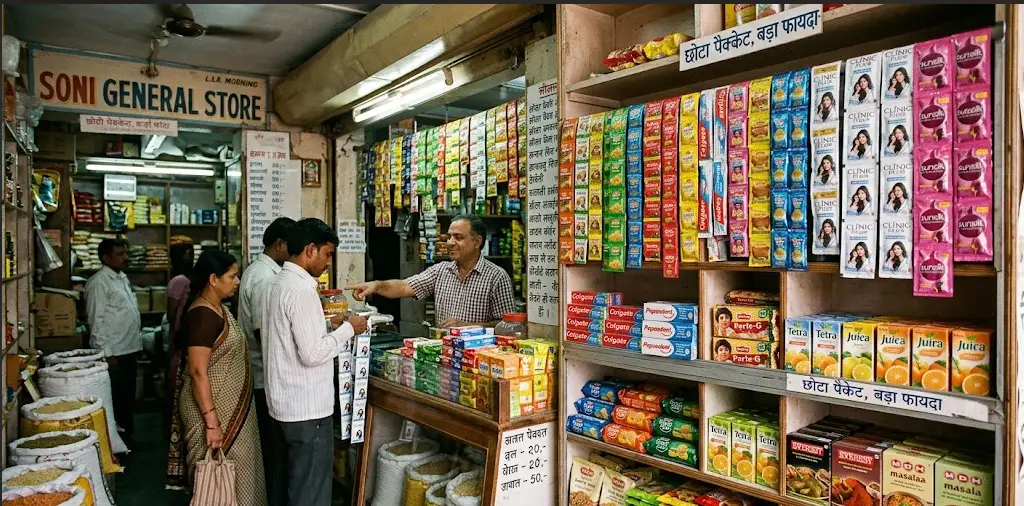
The ₹5 and ₹10 pack is no longer merely a response to inflation. It is becoming a powerful tool for trial, control, convenience, aspiration and habit and FMCG brands are beginning to design around the behaviour, not just the product.
Walk into almost any Indian kirana store and the change is hard to miss. Sachets hang in colourful rows, ₹5 and ₹10 packs occupy prime counter space, shampoos come in single-use formats, snacks are available in handful-sized portions, and even premium products are finding their way into smaller, more accessible packs.
The obvious explanation is inflation. And inflation certainly matters. Indian shoppers have become more price-conscious, with NIQ reporting that higher unit growth relative to volume has been signalling a preference for smaller packs. Its 2026 India FMCG work also identifies affordability pressure and ₹5/₹10 price-point disruption as important forces shaping the market. But reducing the phenomenon to affordability misses the more interesting story.
Indian consumers are not simply managing money. They are managing commitment.A ₹100 pack represents a larger decision. A ₹10 pack feels almost frictionless. One requires confidence that the product will be useful for weeks; the other can be bought for today, for a particular occasion, or simply to try something new. The mathematics may favour the larger pack. Human behaviour does not always follow mathematics. That is where the small pack becomes much more than a smaller package.
The Pack Is Becoming a Behavioural Device
For years, packaging was largely treated as a functional layer around the product. Put the product inside, communicate the brand, show the price and get it onto the shelf. Today, the pack itself can influence the nature of the decision. ₹10 is not merely a price. It can be a low level of commitment. A single-use sachet is not merely less product. It can represent convenience, control and immediate consumption. A trial pack is not merely a smaller SKU. It can reduce the psychological cost of trying something unfamiliar. This distinction is increasingly important because the first purchase is often the hardest purchase a brand has to win. Roosevelt Dsouza, head of customer success–FMCG at NielsenIQ, has described smaller packs as offering a lower entry cost and making consumers more willing to try new brands and products, particularly aspirational brands in rural markets. (India Today)
That is a powerful shift in the role of packaging. The pack is no longer simply carrying the product to the consumer. It is carrying the consumer into the brand.
From Affordability to Access
India has always had a remarkable relationship with price points. ₹1. ₹5. ₹10. ₹20. These are not just numbers on a shelf. They are familiar mental benchmarks. They make spending feel manageable, immediate and predictable. This has made the Indian market unusually fertile ground for small-format innovation. But the modern small pack is evolving beyond the traditional mass-market sachet. In 2025, major FMCG companies including Hindustan Unilever, Britannia, ITC and Colgate-Palmolive were introducing smaller “access packs” of premium products. HUL, for instance, introduced a ₹10 pack of Surf Excel liquid, while ITC pushed smaller formats across brands such as Fiama, Engage and Dark Fantasy. Britannia executive director Rajneet Singh Kohli put the strategic logic simply: consumers need an opportunity to try a product. (The Economic Times)
That is the more interesting future of the small pack. It can democratise access to premiumisation. A consumer who may hesitate at a ₹500 purchase may be perfectly comfortable experimenting with a ₹50 format. Once the experience is positive, the larger purchase becomes easier. Try small. Trust. Then trade up. The small pack can therefore work not only as an affordability tool, but as a bridge to aspiration.
The Small Pack Has Changed the Meaning of Trial
Consider what happens when a consumer encounters a new shampoo, snack, coffee, sauce or personal-care product. The traditional barrier is not necessarily the price of the product itself. It is the uncertainty attached to the purchase. A consumer is paying for the possibility that the product will work. A small pack reduces the cost of being wrong.
That is why the sachet has been such a powerful invention in India. Clinic Plus helped establish the logic of shampoo sachets at scale: the consumer did not need to commit to an entire bottle to experience a wash. Nescafé's sachet format turns coffee into a single-serving occasion. The consumer does not need to own a jar before enjoying the product. Maggi's smaller packs work brilliantly around immediate consumption. A ₹10 pack is not simply less noodles; it is a different consumption moment quick, accessible and often spontaneous. Oreo's smaller formats demonstrate another dimension. A brand with strong aspiration and recognition can use a low-entry format to invite consumers into the franchise. The product may be smaller. The invitation is not.
Packaging Is Also Designing the Occasion
This is where the small-pack story becomes particularly interesting for marketers. A ₹10 snack pack bought outside a school, college or workplace behaves differently from a ₹50 family pack sitting in a kitchen cupboard. The brand may be identical. The consumer may even be identical. But the occasion is different. Small packs can therefore create or unlock consumption occasions that larger packs cannot. A small biscuit pack can become a school-time snack. A small coffee sachet can become an office ritual. A small shampoo sachet can become a travel solution. A mini fragrance can become an entry point into premium grooming. A small namkeen pack can become an individual evening snack rather than a household purchase. This is why the right way to think about pack architecture is no longer simply: Pack → Price → Purchase It is increasingly: Pack → Price → Occasion → Frequency → Habit The difference is subtle, but strategically enormous.
From Trial to Habit
The first ₹10 purchase is not the real prize. The second one matters more. Then the third. Eventually, the consumer may stop consciously deciding at all. The brand becomes part of a routine. This is where FMCG economics becomes behavioural economics. A brand does not necessarily build strength by securing one large transaction. It can build strength by becoming an easy, repeatable choice. NIQ has repeatedly observed the importance of smaller packs in India's consumption landscape. Its earlier analysis found that consumers were buying more units even as average pack sizes declined, while its more recent India reports continue to identify higher unit growth as a signal of smaller-pack preference. (NIQ) The implication is important.
Frequency can sometimes be as strategically valuable as volume. A large pack may produce one substantial transaction. A small pack can produce several moments of contact. That does not automatically make the small pack more profitable. Packaging, logistics, margins and distribution economics remain critical. But it changes the way brands can think about growth.
Small Does Not Mean Cheap
There is another misconception worth challenging. Small packs are often associated with lower-income consumers. That is increasingly incomplete. A young professional living alone may prefer smaller quantities because there is less waste. A health-conscious consumer may want portion control. A traveller may want convenience. A curious consumer may want to experiment. A premium consumer may want to experience a product before making a larger investment. Even affluent households increasingly make selective purchases rather than simply buying everything in the largest available format. PwC's 2025 India consumer research points to a market where affordability remains important while emerging consumer segments are also creating opportunities for more specialised SKUs and propositions. The small pack, therefore, can belong to a much broader consumer psychology. It is not necessarily the pack of the consumer who cannot afford more. It can be the pack of the consumer who does not want more. That is a very different proposition.
The New Pack Architecture
The smartest brands will stop treating their smallest pack as merely the cheapest member of a portfolio. Each format can have a job. The smallest pack can drive trial. A ₹10 format can trigger impulse. A single-use pack can solve a specific occasion. A mid-sized pack can support regular consumption. A larger pack can encourage household stocking. Once each pack has a behavioural role, packaging becomes part of brand strategy. This is particularly relevant in categories where brands are fighting for penetration. The small pack can lower the barrier to entry without necessarily weakening the brand. That is precisely why premium brands are increasingly experimenting with access formats. The strategy has two sides: accessibility and availability. As Rajneet Singh Kohli of Britannia noted, smaller access packs give consumers an opportunity to try a product. (The Economic Times) In other words, the small pack can be the first chapter of a premium relationship.
The Kirana Store Still Understands This Brilliantly
There is something beautifully sophisticated about the Indian kirana shelf. It understands consumer behaviour without using the language of consumer behaviour. The ₹5 biscuit pack is there because someone may have ₹5 today. The ₹10 snack is there because someone may want something immediately. The sachet is there because someone may not want to buy the bottle. The small premium pack is there because someone may want to enter a category without making a large commitment. The shelf is effectively offering a ladder of decisions. And Indian consumers are becoming increasingly skilled at moving up and down that ladder depending on the occasion. NIQ's shopper research has found that Indian shoppers are actively adapting to price sensitivity through smaller-quantity purchases and more frequent shopping trips. (NIQ) The small pack fits beautifully into this more fluid shopping behaviour.
But There Is a Trap
There is a danger in turning every small pack into a cheaper pack. If the only strategy is to reduce quantity and protect a familiar price point, brands can end up in an endless race toward lower prices and lower grammage. That creates little differentiation. The stronger strategy is to give every format a reason to exist. A pack should answer a consumer need trial, portability, portion, impulse, affordability, convenience, premium access or regular consumption. That is where design becomes strategic. Not decorative. Not merely attractive. Strategic. The best packaging does not simply communicate what is inside. It communicates why this particular format makes sense for this particular moment.
The Bigger FMCG Shift
The small-pack economy is ultimately telling us something larger about the Indian consumer. Consumers are becoming more deliberate about where they put their money, their space, their time and their attention. NIQ's 2026 pricing research describes the market as increasingly value-driven, with price-pack architecture becoming critical to protecting penetration and unlocking value growth. (NIQ) That makes the pack an increasingly important strategic lever. The future may not belong only to brands that sell more. It may belong to brands that become relevant more often. The winning brand may be the one that appears at the right price, in the right quantity, at the right moment, for the right occasion. That is a much more sophisticated role for packaging than simply putting a product on a shelf.
WHAT. SO WHAT. NOW WHAT.
Small packs are gaining importance across Indian FMCG because of affordability pressures, but the behaviour goes beyond inflation. Consumers are also responding to smaller formats because they offer lower commitment, lower risk, greater control and easier access to new products. (NIQ) A small pack can change the consumer journey. It can transform an unfamiliar product into an affordable experiment, an experiment into a repeat purchase, and a repeat purchase into a habit. That makes packaging a behavioural asset. Brands need to move beyond the idea of the “cheapest pack”. They need to build a purposeful pack-price architecture in which every format has a clear role: Trial → Impulse → Occasion → Regular Use → Stocking The strategic starting point is not the size of the pack. It is the behaviour the brand wants to create.
BRAND TO WATCH TAKE
The Indian consumer is not always trying to buy less. Sometimes, the consumer is simply trying to commit less.That distinction may become one of the most important insights in the next phase of FMCG marketing. Because a small pack can do something a large pack cannot always do. It can make a brand feel easy. Easy to try. Easy to buy. Easy to carry. Easy to consume. And, eventually, easy to repeat. The ₹10 pack may look small on the shelf. But strategically, it can open a much bigger door.
Small Pack. Big Behaviour.