
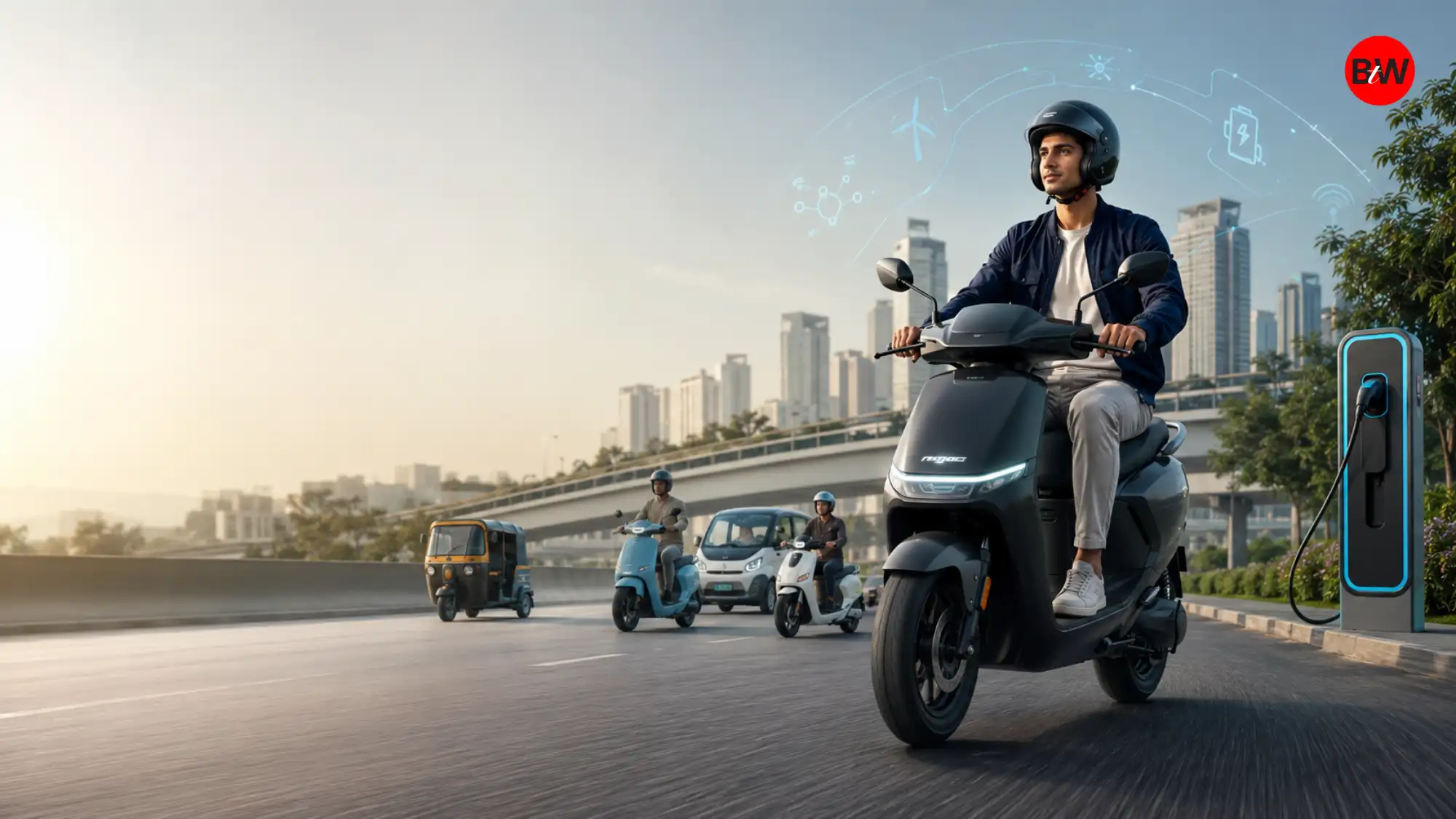
For years, electric vehicles were discussed in India with the language usually reserved for the future. It was the next big thing. It was coming. It was inevitable. But “inevitable” is an interesting word in business. It can describe something that is certain to happen, while simultaneously permitting everyone to wait. The Indian electric-vehicle market appears to have crossed that waiting period. The more important question now is no longer whether Indians will adopt electric mobility. The question is what happens when electric mobility becomes ordinary.
That distinction matters. A technology becomes truly disruptive not when people admire it, but when they stop noticing it. The smartphone did not change India merely because it was technologically impressive. It changed India when people stopped calling it a smartphone and simply called it a phone. Electric two-wheelers are beginning to approach that moment. In July 2026, India's electric two-wheeler retail market crossed the two-lakh mark for the first time, with around 2.04 lakh units sold, according to FADA data reported by industry publications. That represented more than 11% of the total two-wheeler retail market.
The number is significant not simply because it is large, but because of what it says about consumer behaviour. An 11% share means electric scooters are no longer being purchased only by technology enthusiasts, environmentalists or early adopters. They are entering the consideration set of the ordinary Indian two-wheeler buyer. That is a much more consequential development. The Indian automobile market has always been brutally practical. Consumers ask about mileage, maintenance, resale value, financing, service availability, and reliability. The electric vehicle is now being subjected to the same questions. That is perhaps the clearest indication that the category is growing up.
Globally, the story is even larger, although it is unfolding differently. The International Energy Agency expects electric-car sales to reach around 23 million units globally in 2026, representing approximately 28% of total new-car sales. But the global headline hides very different regional realities. China is approaching electric-car penetration levels that would have appeared extraordinary only a few years ago. Europe is accelerating. The United States remains more sensitive to policy changes. Meanwhile, emerging markets are developing a different path, often led by two- and three-wheelers rather than cars. The IEA notes that electric two- and three-wheeler adoption is particularly attractive in emerging economies because consumers are highly sensitive to fuel costs and have lower rates of motorisation.
India belongs to that latter story. It does not need to replicate China's EV journey, nor does it need to imitate Europe's. India's automobile market has always been structurally different. A significant part of daily mobility happens on two wheels. A scooter is not necessarily a second vehicle in an affluent household; for millions of Indians, it is the primary vehicle. It takes people to work, children to school, groceries home, parcels across town and small businesses from one customer to another. Electrifying that vehicle therefore has an economic consequence far beyond the automobile industry. It changes the running cost of everyday mobility.
This is why the electric two-wheeler may eventually prove more important to India's EV transition than the electric luxury car. A premium electric car makes a statement about technology. An electric scooter changes household economics. And when a product changes household economics, adoption can become much deeper.
The first quarter of FY2027 offered an early indication of that momentum. April, May and June each delivered progressively stronger electric two-wheeler volumes, with June approaching 1.95 lakh registrations. By July, the segment had crossed the two-lakh monthly threshold. Industry data also shows that electric two-wheeler sales in the first seven months of calendar 2026 were up sharply year-on-year. The important point is not that every month will necessarily be higher than the previous one. Automobile markets do not move in straight lines. The important point is that the baseline itself is moving upward and that changes the competitive battle.
For a long time, the EV conversation in India was dominated by start-ups. They had the technology, the excitement, and the audacity to challenge the established automobile order. But the second phase of the market is beginning to favour a different asset: institutional trust. This is where TVS Motor's rise becomes particularly interesting.
TVS has not tried to reinvent what an Indian scooter means. It has done something more commercially intelligent. It has taken an established brand, an established dealer network, established manufacturing capability, and established service infrastructure and put an electric product inside that ecosystem. In July, TVS sold roughly 55,500 electric two-wheelers, giving it about 27% of the electric two-wheeler market and its strongest monthly performance yet.
There is a deeper strategic lesson here. A consumer buying an electric scooter from TVS is not only buying an electric scooter. He is buying the reassurance that comes with TVS. The same principle explains the strength of Bajaj's Chetak. Chetak is not merely an electric product. It is an old piece of Indian brand memory that has been given a new powertrain.
Bajaj sold roughly 45,600 electric two-wheelers in July, retaining the second position. The significance of Chetak lies in the fact that Bajaj did not have to teach the consumer who it was. It already had permission to enter the household. The EV proposition therefore becomes less about asking consumers to trust a new technology and more about asking them to trust a familiar brand with new technology.
That may become one of the defining characteristics of India's next EV phase. The first generation of electric mobility was about technology overcoming distrust. The second generation may be about trusted brands making technology feel normal.
Ather represents another route. It has built its identity around technology, design, performance, and the broader digital experience. Its July sales of around 30,400 units represented growth of more than 70% over the previous year. Ather's opportunity is particularly interesting because electric vehicles eventually lose one of their biggest differentiators: the fact that they are electric. When every manufacturer offers an electric scooter, “electric” stops being a positioning statement. It becomes a category descriptor. At that point, design, software, performance, charging experience, and brand personality become more important.
This is precisely why Ather matters. It is competing not merely on propulsion but on experience.
Then there is Ola Electric, which perhaps represents the most instructive story of the first phase of India's EV revolution. Ola demonstrated how quickly a new brand could create attention, scale and ambition around electric mobility. But the market has subsequently shown that manufacturing a vehicle and building an automobile business are two different challenges. In July, Ola's electric two-wheeler retail sales were around 14,100, down more than 23% year-on-year, even as several established competitors grew strongly.
The lesson is not that start-ups cannot win. The lesson is that the definition of winning has changed.
An electric vehicle is not simply a battery, motor, and screen. It is a five-year relationship. The consumer wants to know where the service centre is, whether spare parts will be available, what happens to the battery after several years, how much the vehicle will be worth in the used market, and whether the company will still support the product. The industry's next competitive advantage may therefore be less visible than horsepower or range. It may simply be reliability.
That is why Hero's VIDA deserves attention as well. Hero MotoCorp possesses something that most EV start-ups cannot manufacture overnight: an enormous distribution and service ecosystem. The question is whether VIDA can convert that structural advantage into a compelling electric brand proposition. If it can, the competitive landscape becomes considerably more difficult for pure-play EV companies.
This is also why the next twelve months are important. Q2, Q3 and Q4 will tell us whether the current acceleration represents a structural shift or simply a particularly strong phase of the cycle. July has already given the market a strong opening. The festive season in Q3 could provide another test because Indian consumers traditionally bring forward major purchases around this period. If electric two-wheelers can sustain two-lakh-plus monthly volumes through the festive quarter, the category will have demonstrated something more important than growth: repeatability.
Q4 will then become the test of durability. The January-to-March period traditionally brings its own combination of financial-year-end buying, promotional activity and manufacturer targets. If the market enters Q4 with a significantly larger installed base, wider distribution and more products, the momentum could become self-reinforcing.
But there is one issue that could slow everything down: infrastructure.
The charging conversation in India has often become a numbers game. How many chargers are there? How many are being installed? How many more are planned? But the consumer does not experience infrastructure as a number. He experiences it as a moment. He arrives at a charging point and either it works, or it doesn't.
The government has allocated ₹2,000 crore under PM E-DRIVE for public EV charging infrastructure. As of June 30, 2026, ₹689 crore had been approved for the deployment of 6,562 chargers across nine states and three oil marketing companies. That is meaningful progress, but the next challenge is going to be quality rather than merely quantity.
A charger that is unavailable, broken, incompatible, or difficult to locate does not create consumer confidence. The next infrastructure metric, therefore, should perhaps not be the number of chargers installed. It should be the number of chargers a consumer can confidently depend upon.
Fortunately, electric two-wheelers have an advantage that electric cars do not. They do not necessarily need a nationwide network of fast chargers to make the transition work. A scooter can charge at home. It can charge at a workplace. It can charge at a dealership or destination. This means India may not need to copy the charging infrastructure model of Europe or China. It may develop a more decentralised Indian model, built around everyday destinations rather than long-distance travel alone.
The more interesting problem may eventually be the electricity grid itself. If millions of vehicles begin charging simultaneously, the question will no longer be whether India has enough electricity in aggregate. It will be whether electricity is available at the right place and at the right time. Smart charging, distributed energy, solar generation, storage and time-based electricity pricing could therefore become as important to the EV story as batteries themselves. And then there is the battery.
For the first generation of EV consumers, range anxiety was the great psychological barrier. The next generation may have a different anxiety: battery life. How much will it degrade? What will replacement cost? What happens after the warranty? Will the battery affect resale value? Can it be recycled?
That is why the next great EV proposition may not be “200 km range”. It may be something far more emotionally powerful: peace of mind.
The winning brand may ultimately be the one that tells the consumer, with credibility, not merely how far the vehicle can travel today, but how confidently it can be owned for the next five or seven years.
This also explains why the EV industry is slowly becoming larger than the automobile industry. Batteries will become businesses in their own right. Charging will become a service business. Software will become part of vehicle ownership. Battery recycling and second-life applications will become increasingly important. Financing and insurance will develop EV-specific propositions. Used electric vehicles will eventually become a major market of their own.
The car or scooter, in other words, is only the visible part of the EV economy. The deeper transformation is happening underneath it.
The first EV race was about who could build an electric vehicle. The second was about who could sell one. The next race will be about who can build a sustainable business around one.
That requires a very different combination of strengths. Product matters. Price matters. Range matters. But distribution matters. Service matters. Software matters. Financing matters. Brand trust matters. And increasingly, the entire ownership ecosystem matters.
This is where India's EV market becomes particularly fascinating from a brand perspective. TVS has scale. Bajaj has heritage. Ather has technology and experience. Hero has distribution. Ola has disruption. None of these advantages is sufficient by itself. The eventual winner may be the company that combines the greatest number of them without losing its identity.
That is why the next phase of India's electric two-wheeler market should not be read simply as a sales chart. It should be read as a battle between different definitions of value.
For TVS, value can mean reassurance. For Bajaj, it can mean familiarity. For Ather, experience. For Ola, disruption. For Hero, reach.
The market will decide which meaning matters most, and perhaps that is the most important shift of all. The Indian consumer is no longer asking whether an electric scooter is the future. The consumer is beginning to ask whether it is a better present.
Once that question becomes mainstream, the market changes permanently. The electric vehicle will no longer need to be sold as a revolution. It will simply need to be sold as a better scooter, and that is when the real EV revolution will have begun.
The next EV war will not necessarily be won by the brand with the biggest battery, the longest range, or the most futuristic dashboard. It will be won by the brand that makes the consumer feel, five years after purchase, that he made the right decision.
Because the first generation of EVs sold technology. The next generation will sell confidence. And in India, that confidence may arrive quietly, on two wheels, outside an ordinary home, without the sound of an engine.