A brand rarely disappears overnight. In most cases, the decline begins much earlier, when the business is still growing, valuations are rising, stores are opening, customers are increasing, and the market is celebrating its success. From the outside, everything looks healthy. But underneath, the business model may already be weakening.
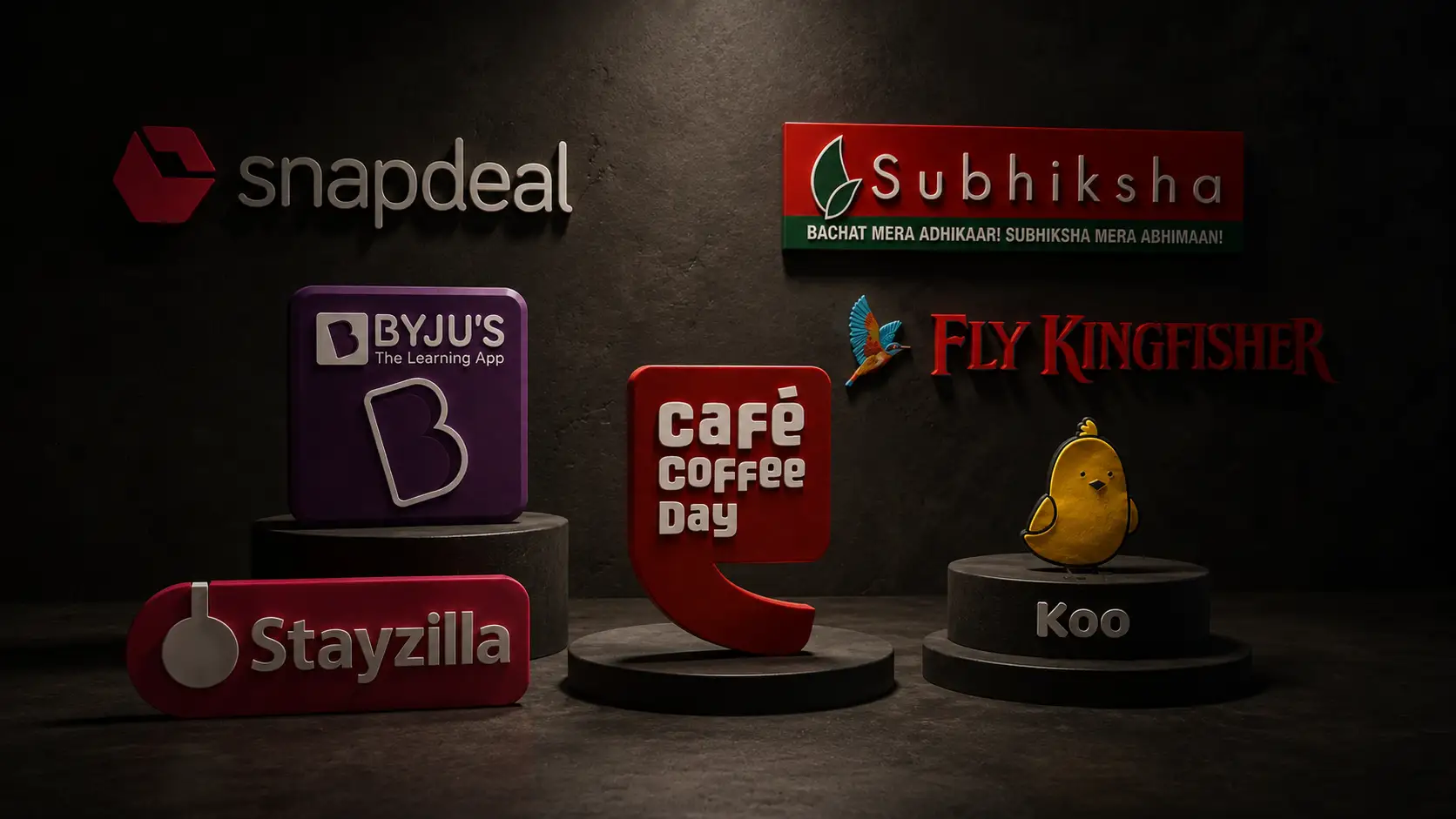
India has seen several such stories across startups and traditional businesses. Snapdeal, Byju’s, Subhiksha, Café Coffee Day, Kingfisher Airlines, Koo and Stayzilla all became symbols of ambition in their respective categories. Yet each faced a different turning point where growth, strategy, finance, or changing consumer behaviour created a serious challenge.
Snapdeal is perhaps the clearest example of growth moving faster than strategy. Once valued at around $6.5 billion, the company was seen as a potential Indian Alibaba. But it struggled to keep pace with Amazon and Flipkart in smartphones, product quality, fashion, and customer experience. Heavy marketing and expansion could not compensate for weakening fundamentals.
Byju’s represents another kind of story: extraordinary growth without the same level of organisational and financial discipline. Once valued at around $22 billion, the edtech giant expanded rapidly through technology, acquisitions and aggressive growth. But changing post-pandemic demand, financial pressures, governance concerns, and investor disputes eventually pushed the company into a severe crisis. The lesson is clear: the bigger the organisation becomes, the stronger its governance and financial discipline must become.
Subhiksha was one of India’s early large-scale retail success stories. It built a huge network of discount stores and at one point operated more than 1,600 stores. But rapid expansion, debt, liquidity problems, and operational difficulties eventually brought the business down. Its story is a classic reminder that store count is not the same as business strength.
Café Coffee Day created an entirely new café culture in India and built tremendous consumer familiarity. But a powerful consumer brand could not completely protect the business from financial stress and a heavy debt burden. CCD demonstrates an important distinction: brand equity and financial health are two different assets. A loved brand still needs healthy cash flow and a sustainable business structure.
Kingfisher Airlines created one of the most aspirational brands in Indian aviation. Its promise was built around service, experience, and glamour. But aviation is ultimately a capital-intensive business with enormous operating costs. Financial stress, mounting liabilities, and operational difficulties eventually brought the airline's operations to a halt. The lesson is powerful: a great customer experience cannot permanently compensate for weak business economics.
Koo presents a more contemporary example. It built a strong narrative around becoming an Indian alternative to global social-media platforms, with a particular focus on Indian languages. But user growth did not translate into a sustainable business model, funding became difficult, and the company eventually shut down. Its story highlights a modern startup reality: user acquisition is only half the journey; sustainable monetisation is the real test.
Stayzilla, meanwhile, shows how a promising market opportunity can still fail to become a sustainable business. It built a significant presence in travel and hospitality, but competition, operating costs, and profitability challenges eventually forced the company to shut down its operations.
What connects these stories is not one common mistake. Their industries, customers, and business models were very different. But several patterns appear again and again: growth became faster than the underlying business; funding was treated as fuel for expansion rather than as a resource requiring discipline; market changes were not always anticipated quickly enough; brand building sometimes moved ahead of business fundamentals; and expansion created complexity faster than the organisation could manage it.
That is why this should not be a series about “failed brands.” It should be a series about turning points.
The more interesting question is not “Why did this brand fail?” but: “At what point did this brand stop winning?”